
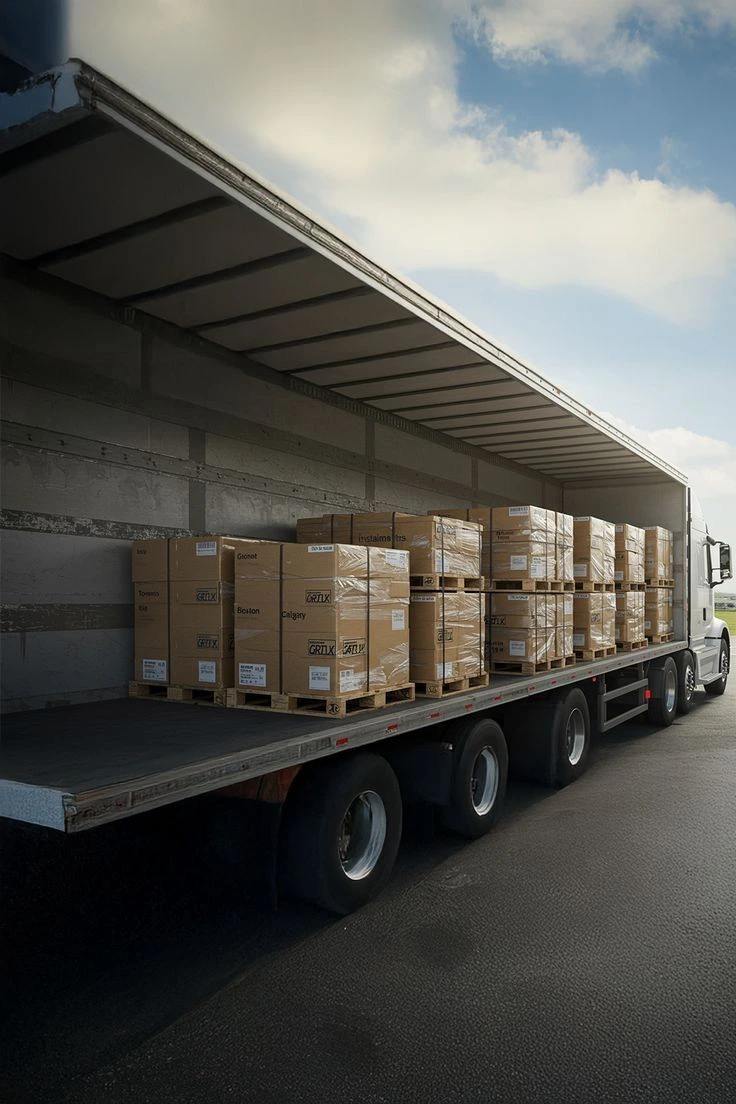
Most of the damage in land freight has its root in wrong loading and arrangement; a consignment that is not properly secured shifts on the curves or under the brakes along the route, gets damaged and can even become dangerous for the driver and other vehicles. Correct loading both guarantees safety and prevents the hidden costs that come from damage. In this article we examine the principles of loading and arranging the goods in land freight.
Basic principles of loading
Regardless of the type of the goods, a few basic principles are common to all loading:
- Weight distribution: the weight must be spread in a balanced way over the axles to prevent overturning or uneven pressure.
- Priority to the heavy load: the heavy loads at the bottom and in the centre, the light ones on top of them.
- Proper securing: the load must be locked to the body of the truck with suitable straps and lashings so that it does not move along the route.
Note: an incorrect arrangement is one of the most common reasons for referring the consignment to inspection and for a stop at the border. Before departure, make sure the load is well wrapped and secured so that you do not run into trouble in the customs inspection.
The steps of a correct loading
1. Capacity planning
Before loading, check the dimensions and the weight of each carton or item and draw the arrangement map. Knowing the exact volume helps you choose correctly between full- and less-than-truck; the comparison is in full or less-than-truck.
2. Distributing the weight over the axles
Place the heavier load in the centre and lower down on the floor of the truck, and avoid concentrating all the load on one side. This keeps the balance on the curves.
3. Layer-by-layer arrangement
- the first layer: the heavy and large loads on the floor
- the next layers: the lighter and packaged loads
- fill the gaps to prevent movement
4. Final securing and fixing
Lock the load to the body with straps, lashing and locks, and at the end of the route check the lashings several times.
Common mistakes in loading
- Loading over the truck’s axle capacity
- placing a light load under a heavy one
- incomplete lashing or using an unsuitable strap
- not filling the empty space, which leads to movement
- ignoring the packing requirements of the goods
Read the export packing requirements in export packing; the principles and requirements.
The requirements of special goods
- Perishable and refrigerated goods: need a truck equipped with a cooling system and a fast loading.
- sensitive and fragile goods: need foam, padding and separation from heavy loads.
- liquids and drums: special securing and prevention of spillover.
Each of these goods may need special storage conditions; before the departure, coordinate the appropriate conditions with a freight expert.
FAQ
Where should I concentrate the load?
In the centre of the truck’s floor and balanced over the axle; the heavy load at the bottom, the light one on top. Avoid concentrating it on one side.
Do I need special equipment for securing the load?
Yes, tightening straps, lashing rings and standard lashing tools are required, and their quality has a direct effect on the safety and integrity of the load.
What happens if my load shifts during the journey?
Besides the risk of physical damage, at the border it can cause a referral to inspection and a stop; that is, the same hidden costs of clearance you should avoid.
Summary
A correct loading is the first and most important step for the goods to arrive at their destination safely and on time. With proper weight distribution, a layer-by-layer arrangement and a correct securing, you both guarantee safety and prevent the stops and costly damages. The Vira Farabar Logistics team carries out the loading and securing of your shipment under the supervision of an operations operator, so that the goods arrive undamaged even to the point of delivery at your door.