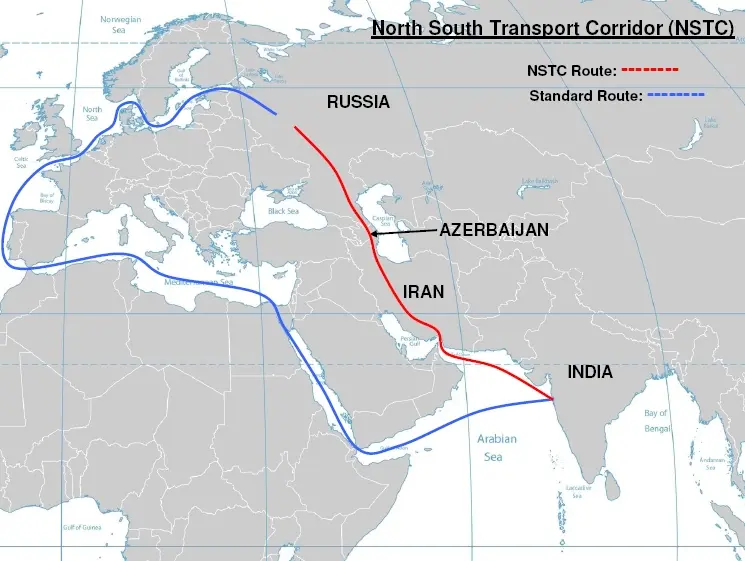
The Astara terminal is becoming a key logistics hub in the North–South corridor. With the development of the road capacity (350 to 400 trucks a day) and the connection to the rail network, this terminal can be the point of connection between road, rail and sea transport at the Iran–Azerbaijan border.
Why does Astara become a hub?
Geographical position
Astara lies on the route of the North–South corridor; a route that connects the southern ports of Iran to Azerbaijan, Russia and Northern Europe. This position has made Astara the entry and exit point of goods for two countries.
Complementary capacities
- Road: a target capacity of 350 to 400 trucks a day (the Astara border)
- Rail: a connection to the railway line and proximity to the Rasht–Astara project (the Rasht–Astara railway)
- Transit: the new transport agreements between Iran and Azerbaijan (the transport agreements)
How does combined transport work at Astara?
In a logistics hub, goods are moved between two or more modes of transport:
- Initial loading: the goods arrive at Astara by truck from the origin (for example Tehran or Urmia)
- Transfer: the cargo is moved from truck to rail or vice versa
- Continuing the route: the goods go on by rail to Baku, Russia or the Caspian ports
This model is economical for container and high-volume consignments. To better understand the advantage of combined transport, read the combined transport guide.
Business opportunities
- Exports to the CIS and Russia: a shorter and better-coordinated route than before
- Transit of third countries: attracting cargo from Georgia, Armenia and even European countries
- Investment in ancillary services: warehousing, weighing, container repair and customs services
Advantages and disadvantages of combined transport at Astara
| Aspect | Advantage | Note |
|---|---|---|
| Cost | lower cost for high-volume consignments | needs a careful calculation of each stage |
| Time | suitable for long distances | requires coordination between truck and rail |
| Flexibility | access to destinations with rail and road | suitable for containers and bulk |
| Risk | reduces dependence on a single route | multi-stage insurance is essential |
Practical tips for using the Astara hub
- Choose the right goods: container, bulk and high-volume consignments are the best option for this route
- Calculate the cost of the two modes: combined transport requires a careful calculation of the cost of each stage (calculating the landed cost)
- Take out full insurance: with the goods passing through several countries, multi-stage insurance is essential (cargo insurance guide)
- Stay coordinated with a forwarder: simultaneous scheduling of truck and rail is the skill of a specialized forwarder (guide to choosing a forwarder)
FAQ
What role does the Astara terminal play in the North–South corridor?
It is the point of connection between road, rail and transit transport between Iran and Azerbaijan and the route of goods to the CIS and Russia.
What is combined transport?
The combination of two or more modes of transport (road, rail, sea) to deliver the goods with the lowest cost and time.
What goods are suitable for transport from Astara?
Container, bulk and high-volume consignments that cover a long and multi-country distance.
Is Astara also useful for the transit of third countries?
Yes; with the development of the hub, there is a capacity to attract cargo from the regional countries.
Summary
The Astara terminal, by combining the road and rail capacity, is becoming the logistics hub of the North–South corridor. A trader who has his eye on the CIS and Russian market should get to know this hub and coordinate his transport plan with it. Vira Farabar Logistics in Urmia is ready to provide combined and transit transport solutions; contact us.